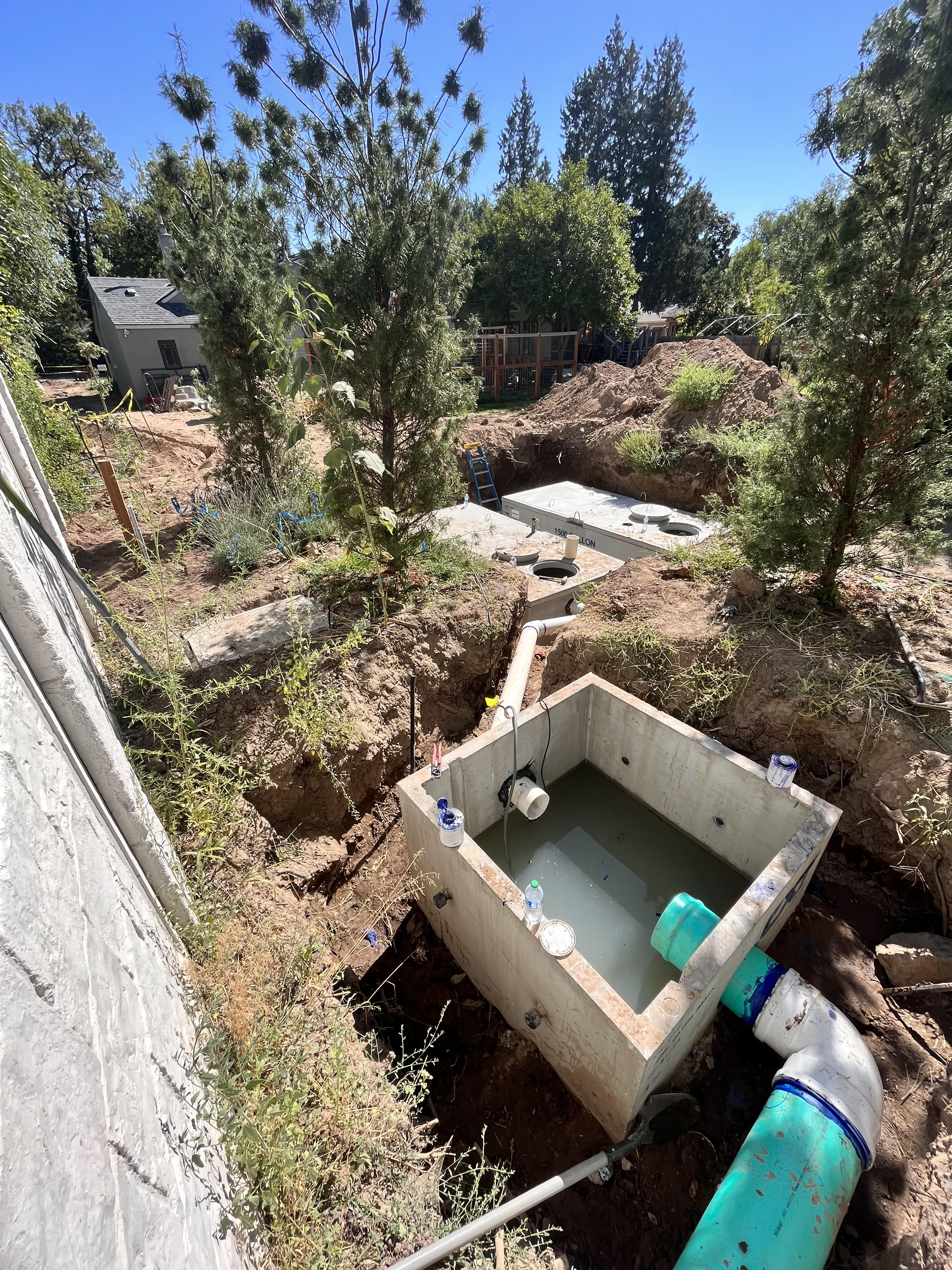
Dry Grass and a Flooded Backyard at the Same Time
Every summer, once Boise, Meridian, Nampa, Kuna and the rest of the Treasure Valley start stacking up days at or above 100 degrees, we start getting the same call. Why is my new backyard flooding when my grass still looks dry?
The first assumption is almost always a sprinkler leak, a broken sprinkler head, a leaking valve or a damaged irrigation line. Sometimes that is exactly what is happening, and we find it in the first ten minutes.
But in a lot of newer subdivisions there is another factor homeowners cannot see, because the problem is underneath the lawn. Many newer Treasure Valley neighborhoods were built on former agricultural ground, and the soil under a finished lawn can be very different from the rich farm soil that used to be at the surface. Combine that with longer summer watering schedules and the way new lots are graded for drainage, and you can end up with standing water even when the sprinkler system is running exactly the way it should.
What Happened to the Agricultural Soil?
A huge amount of Treasure Valley development has taken place on land that was farmed for decades. Drive through south Meridian, Kuna, north Nampa, Star, Caldwell or the edges of Eagle and you can watch the transition happening in real time, with fields on one side of the road and new rooftops on the other.
Those fields usually had deep, healthy topsoil at the surface that absorbed and held water extremely well. During development and construction, much of that existing topsoil may be stripped, moved, stockpiled, sold or reused while the site is excavated, graded and prepared for roads, utilities, foundations and homes.
Once construction wraps up, landscaping and sod go in over the finished grade. The yard can look great from the surface while what sits underneath it is dramatically different from the original farm ground. Instead of deep topsoil, the lawn may be sitting over harder, rockier or more compacted subsoil. That difference does not matter much until you start applying irrigation water.
This is a general comparison, not a description of every lot. Soil depth and compaction vary from one neighborhood to the next and sometimes from one side of a yard to the other.
This Can Happen in New Neighborhoods Across the Treasure Valley
This is not unique to one builder or one subdivision. Homeowners in communities built by many different Treasure Valley builders run into very different soil and drainage conditions from one neighborhood, or even one lot, to the next.
A newer home in Meridian may have completely different soil than a newer home in Kuna. A subdivision in Nampa may behave differently than one in Star. Even two neighboring yards can absorb irrigation water differently depending on grading, soil depth, compaction, landscaping and how the yard was finished. The important thing is not the name on the house. It is what is underneath your lawn, and how fast that soil can take the water your sprinkler system is putting down.
Why New Construction Soil Causes Standing Water
Healthy topsoil absorbs water and lets it keep moving deeper into the ground. Rocky or compacted subsoil accepts it much more slowly. Your sprinkler heads do not know the difference, so they keep applying water at the same rate.
Eventually the soil hits a point where it cannot absorb water as fast as the sprinkler system is delivering it. At that moment the water starts moving across the surface instead of down. That is irrigation runoff. The sprinkler zone keeps running, but the extra water is traveling across the lawn toward a lower area rather than soaking toward the grass roots. Wherever it finally stops. That is where the standing water shows up.
Common Symptoms of New Construction Drainage Problems
If that sounds like your yard, do not jump straight to assuming you need a major sprinkler repair. The first job is figuring out whether the water is coming from a system failure or simply moving across soil that cannot absorb it fast enough.
The Three Things Causing It
Your soil cannot absorb water fast enough
This is usually the biggest piece. A finished lawn may only have a limited amount of good landscaping soil before you hit harder construction soil underneath. Once that upper layer saturates, water starts moving sideways instead of down.
What You See
The zone starts normally. After several minutes water begins running across the lawn, then collects along a fence, in a corner, in a swale or in another low part of the yard.What Is Happening
Your sprinkler system may be working correctly. The soil just cannot take water as fast as the heads are applying it.The Solution
Apply the water in shorter bursts. Split one long run into shorter cycles with soak time between them so the soil can absorb the first pass before more arrives. This is called cycle and soak watering.Triple digit heat leads to longer run times
This is when it usually becomes obvious. Temperatures climb, the grass looks stressed, brown areas appear, and the natural reaction is to give the lawn more water. The controller goes from 15 minutes to 20, then 25, then 30.
But a longer run time does not change how fast your soil absorbs. If runoff already starts at 10 minutes, the next 20 minutes may not be putting much additional water into the root zone at all. A good portion of it is traveling across the yard.
What You See
One part of the lawn looks dry so you increase the watering schedule. Shortly after, a different part of the backyard starts flooding.What Is Happening
The lawn probably does need more water during extreme heat. The problem is your soil cannot accept all of it in one sitting.The Solution
Do not fix a dry lawn by making every zone run longer. Use shorter cycles with soak time between them. The goal is not more water onto the property. It is more water into the soil.Your lot was graded to move water
New homes are graded so water moves away from the foundation, which is exactly what you want. But water that moves away from the house still has to go somewhere. Treasure Valley subdivisions often include drainage swales, subtle slopes, berms, raised edges and designated low areas that all shape how water travels through a yard.
When the system puts down more water than the soil can absorb, the excess follows the grade until it reaches the lowest point. That usually means back corners, fence lines, property boundaries, drainage swales, landscape beds, low sections of grass, or the area behind a retaining wall. Once the soil there saturates, water starts sitting on the surface.
What You See
A zone is running 20 or 30 feet away from the part of the backyard that is actually flooding.What Is Happening
Water is following the natural grade of the property. The flooded area is not always where the excess water started.The Solution
Run the system and physically follow the water. Watch where it hits the grass, watch when it stops soaking in, then watch where it goes. Most people are surprised how far runoff travels before it becomes visible standing water.How All Three Work Together
For a lot of new construction homes in the Treasure Valley, the sequence looks like this:
That chain explains something that seems contradictory to most homeowners. You really can have dry looking grass and a flooded backyard at the same time. The dry area may genuinely need water. The problem is that the water being applied there is running somewhere else before enough of it soaks into the root zone.
Does This Mean My Sprinkler System Is Fine?
Not necessarily. Real sprinkler problems flood yards every day, and we repair them constantly across Boise, Meridian and Nampa. The list we check includes:
- Broken sprinkler heads
- Cracked sprinkler lines
- Leaking sprinkler valves
- Valves that are not shutting completely
- Incorrect nozzles for the zone
- Poor sprinkler head adjustment
- Excessive run times
- Controller programming problems
- Multiple zones watering the same area
- Damaged irrigation fittings
- Heads spraying sidewalks, fences or landscape beds
A proper sprinkler system inspection should tell you whether the water is coming from an actual irrigation repair issue or from normal irrigation water running across saturated soil. Those are two very different fixes, and guessing wrong costs money either way.
What To Do If Your New Backyard Is Flooding
- Run each zone one at a timeLook for broken heads, leaks, unusual spray patterns, geysers, bubbling water or heads that are not popping up correctly.
- Watch the lawn, not just the headsA sprinkler head can be operating perfectly while the water it produces runs straight across the yard. Watch what happens after the water hits the grass.
- Find out when runoff startsIf the zone is programmed for 20 minutes but runoff begins at 8, pay attention to that. The remaining 12 minutes may be applying water faster than the soil can take it.
- Try cycle and soak wateringBreak one long cycle into several shorter ones and give the lawn time to absorb before the zone runs again.
- Check the low areasWalk the fence lines, swales, back corners, landscaping and property boundaries. Figure out whether water is starting there or just ending up there.
- Check your controllerMake sure zones are not running longer than you think, firing more than once, or watering on days you did not intend. A programming issue can quietly double how much water hits the yard.
- Get an inspection if the source is not obviousBeeline can check the heads, valves, lines, controller settings, zone operation, watering schedule and overall coverage to work out what is actually happening.
New Construction Sprinkler Problems Around the Treasure Valley
New subdivisions keep expanding through Meridian, Kuna, Nampa, Star, Caldwell, Eagle, Middleton and Boise, and every property behaves a little differently. Some yards take irrigation water beautifully. Others start running off surprisingly fast.
That is why copying your neighbor's watering schedule is not always the answer. Your neighbor may have different soil, different heads, different sun exposure, different landscaping and a completely different drainage pattern. Your schedule needs to work for your lawn and your soil.
More Water Does Not Always Mean More Water Reaches the Grass
This is the biggest takeaway. When a Treasure Valley lawn starts looking stressed in extreme heat. It is easy to keep adding run time. But once water starts moving across the surface, more time mostly creates more runoff. You can end up using a lot more water without delivering much more of it to the roots.
The better approach is to understand four things: how quickly your soil absorbs water, how long your zones run before runoff starts, where your property naturally drains, and whether your sprinkler system is actually operating correctly. Once you know those. You can build a watering schedule that works for your yard instead of against it.
The Bottom Line
Many newer Treasure Valley subdivisions sit on land that spent decades as productive farm ground with healthy topsoil at the surface. Development changes that soil profile. Soil is moved, excavated, graded and compacted, then roads, utilities, foundations and homes go in, and landscaping is installed over the finished grade.
The finished backyard can look completely normal from above while behaving very differently once irrigation water is applied. Combine slower absorbing soil, 100 degree weather, longer run times and a yard designed to move water away from the house, and standing water can show up fast.
It does not automatically mean your sprinkler system is broken. It also does not mean you should ignore it. The real question is whether you have a sprinkler repair problem, a watering problem, a soil absorption problem, a drainage problem, or some combination of all four.
Not Sure Why Your New Backyard Is Flooding?
Beeline Sprinkler Repair can inspect your sprinkler system and help determine where the water is actually coming from. We handle sprinkler repair, system troubleshooting, valve repair, head repair, irrigation leak detection, controller troubleshooting and full system inspections throughout Boise, Meridian, Nampa, Kuna, Eagle, Star, Caldwell and Middleton.
Whether your home is in an established Boise neighborhood or a brand new subdivision in Meridian, Kuna, Nampa, Star or Caldwell, the first step is figuring out what the water is actually doing.
Backyard Holding Water?
We inspect the whole system, heads, valves, lines, controller and coverage, and tell you straight whether it is a repair, a schedule, or the soil. Licensed, insured and family owned across the Treasure Valley.
Schedule a Sprinkler Inspection 📞 Call or Text (208) 880-2712Licensed and Insured
Idaho Registered Contractor
Liability Coverage on Every Job

Quick Check
- Time how long a zone runs before water starts moving
- Split that run into two or three shorter cycles
- Leave 30 to 60 minutes between cycles
- Watch the low corners, not the heads